
Argentine Grand Prix
FF1M stayed in South America for the second race of the 1995 season, where FJR and Michael Schumacher were seeking the South American double after a relatively straight-forward win at Interlagos. In qualifying, Damon Hill was the first to set a flying lap with only Gianni Morbidelli able to beat his initial effort. Championship leader Schumacher then bettered Morbidelli’s effort by half a second before Hill responded with a lap that would prove to be unbeatable for his second consecutive pole position, a needed result after losing a certain 2nd at Interlagos thanks to a blown Peugeot. Qualifying 3rd was David Coulthard, which was a good effort considering CBA Racing’s difficult start to the season, while Jan Magnussen put in another good lap to qualify 4th.
Unlike at Interlagos, Hill aced the start, as did Magnussen who outbraked both Schumacher and Coulthard into Curva Uno to assume 2nd. As one CBA tucked in behind the two FJR drivers, the other found himself in the gravel trap after former teammate Jean Alesi’s overtaking attempt into Ascari was, at best, a bit silly, but Olivier Panis was able to rejoin the race. Things continued to go downhill for CBA as at the start of lap 2, Coulthard was overtaken by Gianni Morbidelli and then Mark Blundell followed through at Ascari on the same lap. At the start of the next lap, Blundell made light work of Morbidelli for 4th.
With teams unsure of the grip levels projected for the twisty circuit, the entire field had split their strategies between two and three stops with Blundell in particular very lightly fuelled and Schumacher one of the heaviest on the circuit. Despite the high fuel load, he seemed quicker than his teammate but couldn’t get enough traction coming out of the final corner and was therefore stuck in 3rd. This allowed Hill to use his light fuel load to pull away at around a second per lap, but disaster befell the Willows driver on lap 5 when suspension failure forced him to pull over putting Magnussen into the lead. At the same time, Heinz-Harald Frentzen suffered a similar failure for his second consecutive retirement, but things were going rosily enough for Monolith as Mika Hakkinen pressured Morbidelli into a crash at Ombu on lap 11 to move up to 4th.
Magnussen was doing a good job in the lead, frustrating Schumacher to the point where Blundell cheekily went round the outside at Ascari to move up to 2nd on lap 10 before powering into the lead on the inside of the same corner a lap later. His first stop came on lap 14 which put Magnussen back into the lead. Hakkinen pitted on the same lap and rejoined just in front of a kerfuffle for 11th which Alesi took charge of. Further up front, Magnussen lost charge of his lead on lap 17 when he ran heavily over the kerb exiting Ombu, handing Schumacher the lead which was timely as Nigel Mansell had caught up to the FJR duo. On the next lap, Mansell outbraked Magnussen for 2nd going into Mixtos, but Schumacher being unleashed meant that he started to steadily pull away from the 1988 champion.
Blundell’s early stop had gotten him stuck behind Johnny Herbert which allowed Hakkinen to catch up to him, but it also meant that he was jumped by Schumacher and Mansell when the two made their first stops. Coulthard was the last to make his first stop which allowed him to remain in the points ahead of Gerhard Berger, and he used his fresh tyre advantage to close in on Magnussen’s 5th place. At the front, Mansell had taken on three laps less fuel compared to Schumacher but could only make modest advances on the German’s lead. As for the midfield, Nicola Larini overtook Berger for 7th with a straightforward overtake into the first corner on lap 33, while Taki Inoue’s overtake on Eddie Irvine round the outside at Ascari and Mixtos was considerably more impressive, but somewhat less relevant as it was only for 14th.
Just like the first round of stops, Blundell and Hakkinen pitted together on lap 37 with Blundell holding a two second gap to the Finn, but a sensational stop from Monolith put Hakkinen ahead and a potential podium within reach with two targets to overcome. The first of those was Coulthard, and Hakkinen squeezed past at the start of lap 41 to move up to 4th, but he would have to wait until lap 47 to move up to 3rd courtesy of Magnussen heading for the pits. At this point, Blundell had caught back up to Hakkinen and had more fuel raising the possibility of an overcut. The other Tornado had already made his second pitstop having got to within two seconds of Schumacher, but with the German putting in some quick laps before his final pitstop, the order between the two remained unchanged with an extended lead of six seconds.
The battle for 3rd then reenergised with Hakkinen heading for the pits for his third and final pitstop on lap 54. Magnussen was also heading for the pits, but not for scheduled reasons as a gremlin had developed, and he dropped to 10th. Blundell’s extra two laps gave him a shot at 3rd, but some strong outlaps for Hakkinen ensured his place on the podium. Meanwhile, Magnussen’s issue had put Coulthard 5th and Larini 6th, but the Andrew Racing driver still had another pitstop to make, so the true runner of the final point was Martin Brundle. This wasn’t settled however as Herbert was looking for Tildesley GP’s first career points, but all chances had shattered in the same manner as his right rear suspension. This opened the door for the recovering Magnussen, who walked straight in on lap 62 despite Brundle’s defences on the main straight.
The race then settled down over the last ten laps with Schumacher controlling the situation for his second consecutive win, cementing himself as a championship contender. Mansell continued his renaissance with 2nd while Hakkinen held onto 3rd for his first podium since the 1993 Australian Grand Prix and Monolith’s first in their career. Blundell finished 4th along with the fastest lap of the race, achieved just before his first pitstop, while Coulthard and Magnussen completed the top 6.
San Marino Grand Prix
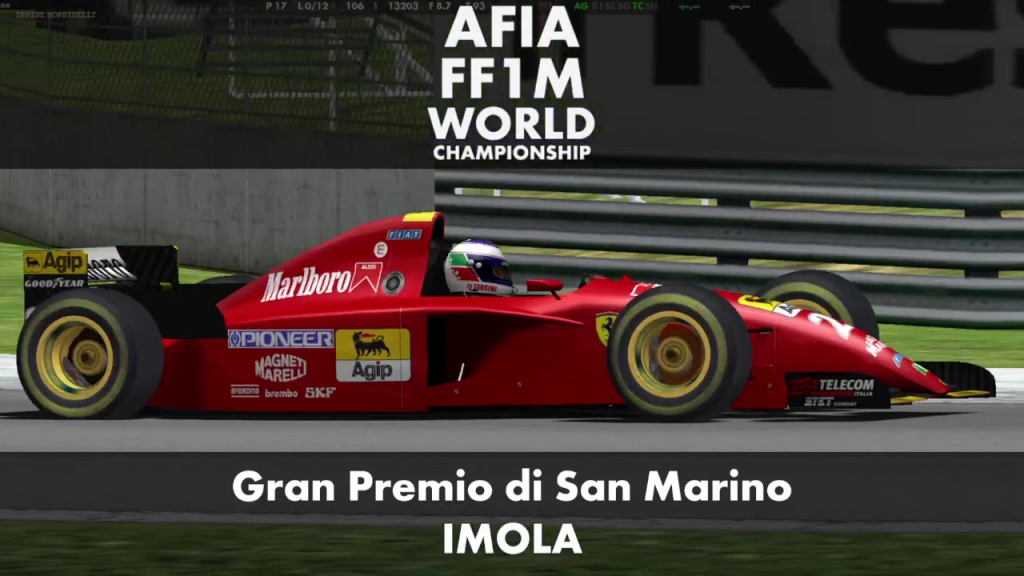
Imola returned to the calendar after safety concerns brought about its absence during the 1994 season. The track was much revised with chicanes added at Tamburello and Villeneuve, but also removed at Acque Minerale and some of Variante Bassa. A further reprofiling was made at Rivazza to extend run-off. Overall, the track had become safer, but more stop-start with the long run from Variante Bassa to Tosa interrupted twice. The changes looked to suit Willows Racing, in particular Mika Salo, who took his first career pole position ahead of his teammate thanks to a great lap on his third run, while Nicola Larini putting in a sterling effort to qualify 3rd ahead of Michael Schumacher.
Off the back of his first ever pole position, Salo’s start was exemplary as he comfortably led into Tamburello with Damon Hill having to fend off the fast-starting Schumacher for 2nd, while Nigel Mansell had a poor start as he lost 5th to David Coulthard and nearly 6th to Jan Magnussen. Further back, there was trouble as aided by Heinz-Harald Frentzen, Taki Inoue piled into the back of Roberto Moreno, scattering debris everywhere. Frentzen and Inoue were able to crawl back to the pits for new wings, but Moreno was an instant retirement, his second consecutive first lap retirement at the circuit having been squashed in between Hill and his teammate in 1993.
Right from the offset, overtaking on the new Imola layout was proving to be extremely difficult with Mansell stuck behind Coulthard. On lap 3, he attempted a somewhat rash manoeuvre on Coulthard into Variante Bassa, collided with the CBA Racing driver, and had a half spin. Only the generosity of Jan Magnussen and Martin Brundle prevented Mansell from losing a place. Being in clear air allowed Mansell to set some fast laps despite being on a two-stop strategy, so it was clear that the Tornado was working well in race trim. Of the frontrunners, Salo and Schumacher had chosen to stop thrice, but despite the lighter fuel load, they weren’t making much of an impression and the sandwiched Hill was easily able to stay with his teammate. A small mistake at Variante Bassa nearly cost Hill 2nd to Schumacher but the Brit held on. The same couldn’t be said of Eddie Irvine, who crashed out at Villeneuve on lap 8 whilst running 13th.
After staring at Coulthard’s rear wing for a few laps, Mansell finally got ahead going into Villeneuve on lap 10 and looked to do something about the four drivers in front, while further back, the attrition rate rose as a broken gearbox decided to do something about Alessandro Zanardi’s race. Lap 13 was when the first round of pitstops began as Salo blinked first, but the race looked good for Hill as he had stayed within two seconds of his teammate despite a heavier fuel load. Schumacher came in two laps later, remained behind Salo and immediately didn’t look comfortable on new tyres. Furthermore, a blown engine for Magnussen raised reliability concerns for FJR. Reliability also took care of Gerhard Berger, Yamaha’s first failure of the season. Then it was Renault’s turn to have a failure in the form of Coulthard, the haze delaying both Salo and Schumacher in the process, and then Jos Verstappen’s race came to an early end for much the same reason as Zanardi’s.
Hill stayed out until lap 23 before making his first pitstop, and his inlaps were such that he rejoined ahead of both Salo and Schumacher, further strengthening his case for a race win. Further back, a huge scrap for 7th was going on as Brundle was holding up a huge train of cars that included Gianni Morbidelli and Mika Hakkinen. In amongst the Brundle brigade, Rubens Barrichello snuck past Johnny Herbert going into Rivazza, while both Morbidelli and Hakkinen headed for the pits with slick pitwork from Monolith allowing Hakkinen to get ahead. A pitstop that wasn’t supposed to happen was Schumacher coming in on lap 25 with a car problem, which dropped him to 6th.
Just as at Buenos Aires, former CBA Racing teammates Jean Alesi and Olivier Panis were in combat with each other on lap 32. In the battle for 11th, Panis missed the apex of the first part of Villeneuve, and then CBA’d with the second apex, spinning into the gravel and rejoining 13th. On the next lap, Mansell performed the overtake of the season so far, outbraking Larini into Variante Bassa with a move so tight that he must’ve been millimetres away from tearing some wheels off. With Salo already having made his second pitstop, Mansell was up to 2nd. He briefly took the lead when Hill came in for his final pitstop on lap 40 but relinquished it two laps later when he made his final pitstop. During this pitstop sequence, Hakkinen was once again impressed by Monolith’s mechanics as the Finn managed to overhaul Brundle in the pits, while an early second stop for Blundell allowed him to undercut Salo for 4th.
During the final stint, Mansell set a new fastest lap which was an ENORMOUS one thousandth of a second faster than Hill’s best lap as he set off after the race leader. In amongst those final laps, Hill was badly delayed by the colliding Alesi and Morbidelli at Variante Bassa on lap 47. The impact ruptured something within Morbidelli’s car as 11 laps later, the Italian bowed out with a blown engine. Despite Mansell’s late charge, Hill was able to control the gap and take his first win since the 1992 Japanese Grand Prix. Yet another 2nd for the consistent Mansell kept him in touch of championship leader Schumacher, but the biggest cheers from the crowd were reserved for their countryman Nicola Larini, who took his first ever podium finish. Blundell’s 4th and Tornado’s policy as a two-driver team meant that they took the lead of the teams championship from FJR, but Salo’s 5th ensured that Willows could potentially make it a three-way fight. Schumacher’s 6th was little consolation for a poor race for FJR.
Paddock News
The reaction to JOCA and the proposed rival racing series, GPMB, has been attention-grabbing, particularly with JOCA president Jaakko Valkoinen claiming that he could bring Ayrton Senna and Alain Prost out of retirement. Both drivers were approached by journalists who asked if they would return to race for an unproven series, but both neither confirmed nor denied this.
In response to the news, the AFIA have put out a statement dismissing JOCA as a “reactionary organisation with no real ambition” and further went on to publicly advise Ayrton Senna and Alain Prost “not to come out of retirement so their achievements and reputation wouldn’t be tarnished,” highlighting Senna’s disastrous 1992 season with Darkfire. In amongst the statement was information about the 1996 FF1M season with some radical rule changes being put forward, mostly relating to the financial side. The AFIA have said that these rules changes are “pretty much final with the official announcement to come before the Monaco Grand Prix.”
About The Author

More Stories
The 2018 Silly Season
2018 Belgian Grand Prix : Drivers of the Day
FF1M 1995 Review : Part 7